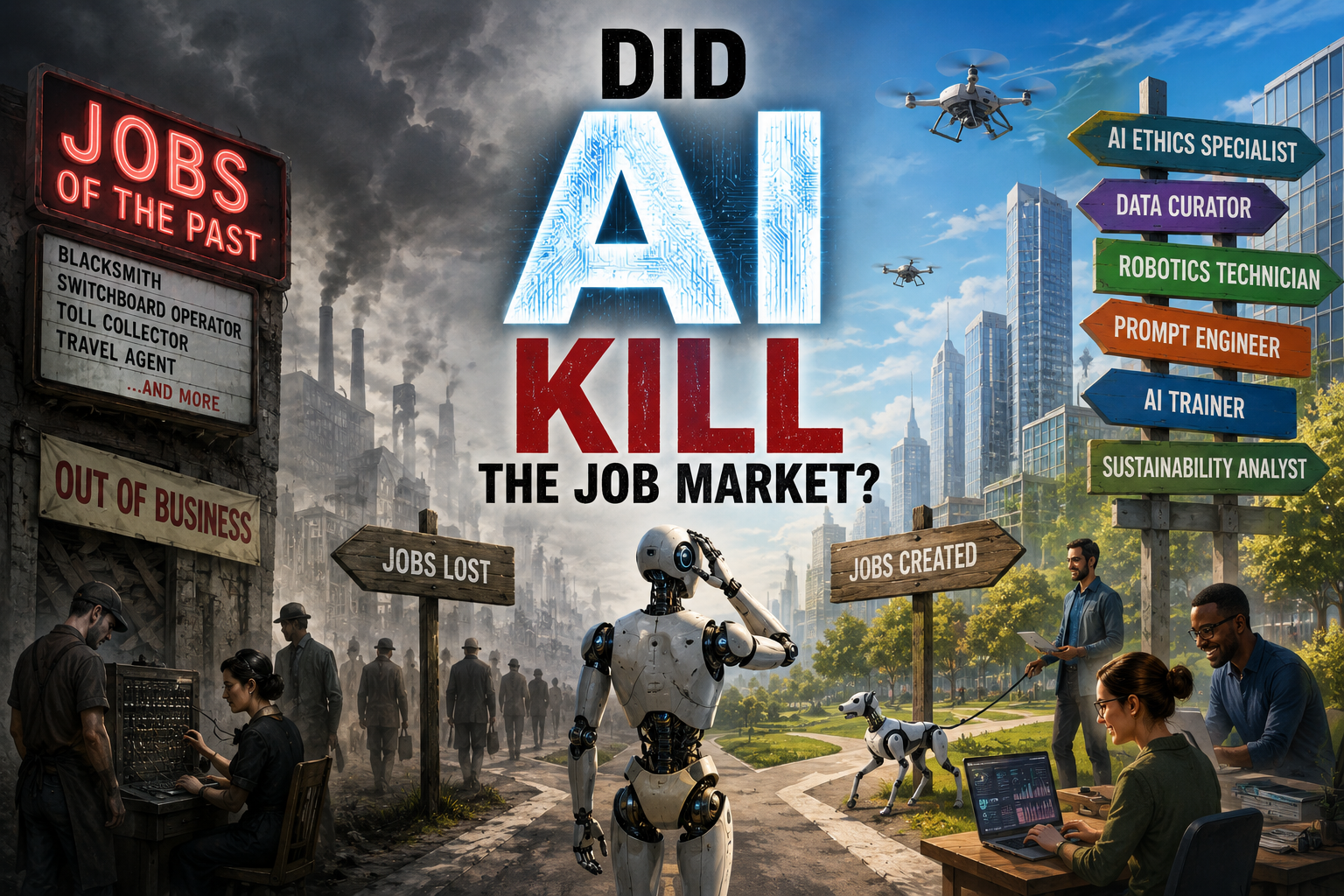
One of the more common worries about the arrival of new technologies is that they will displace workers, resulting in mass unemployment. Yet, the impact that such innovations have on the work force is often much more complex than popularly held fears might suggest.
If you are reading this, you have likely already lived through at least one major disruption caused by technology, whether it was the advent of the internet, the emergence of the smart phone, or the transition from physical memory to the digital kind. And yet, in each of these instances, instead of the sky falling and people losing their livelihoods en masse, we have witnessed something closer to what the creative destruction thesis suggests.
Creative destruction, a term coined by economist Joseph Schumpeter, refers to the tendency for major changes in industrial processes to eliminate old economic structures in favor of new ones, resulting in greater productivity. This phrase has also been applied to labor dynamics, as improvements in areas like communication, manufacturing, and transportation have caused the elimination of some jobs (i.e., blacksmith, switchboard operator) and the simultaneous addition of new ones (i.e., automotive technician, wireless engineer).
Although unsettling for many, the ebb and flow of technological development has not, historically, produced dramatic net job losses that cripple entire industries overnight. Changes to the labor market usually happen at a slower pace than anticipated, giving time for workers to adjust to the new realities, even as existing positions go the way of the buffalo. To be sure, depression, angst, and the need for retraining inevitably come into the picture, with real consequences for those whose jobs are impacted. And while the transition may be difficult for many, it isn’t quite as devastating as imagined either.
And while the transition may be difficult for many, it isn’t quite as devastating as imagined either.
The arrival of artificial intelligence (AI) has once again animated concerns about catastrophic workforce upheaval at the hands of technology. While some, like OpenAI CEO Sam Altman, have issued doomsday declarations about AI-driven downsizing, a review of the available evidence suggests that the dire predictions about job eliminations have not materialized.
For instance, Yale University’s Budget Lab tracks data on how AI might be affecting the labor market. Looking at changes in the proportion of workers in occupations exposed to artificial intelligence, the numbers show that there has been almost no movement since the introduction of ChatGPT in November 2022, whether someone holds a job in a low, middle, or high exposure industry. The curves across all three groups have basically been flat over time.
The curves across all three groups have basically been flat over time.
Next, while it’s true that there are some celebrated cases of specific companies laying off workers due to automation, many of the same enterprises have quietly rehired those same employees back once their error became clear. High-profile examples include Duolingo, Klarna, and Salesforce. This erratic corporate decision-making, in which layoffs due to AI are swiftly reversed, is known as the “AI boomerang effect.”
Finally, while widespread AI adoption has raised suspicions that younger workers will be the most imperiled, new research out of the Federal Reserve Bank of New York paints a different picture. A combination of federal employment data and observations from a Fortune 500 company shows that the apparent downturn in employment for college graduates may be less about replacing workers with AI, and more about not hiring them for remote positions. The hypothesis supplied by the researchers is that employers view new grads as less suitable for remote work since they aren’t as easily trained and mentored like they would be on-site. Therefore, the exceptionally high underemployment rate (42.5%) currently experienced by the newly credentialed is not a function of preemptive job elimination due to AI, but rather an unfortunate side effect of the perception that businesses have about the career readiness of young employees.
To be sure, this essay will not be the last word on the impact that AI will have on the job market. It may come to pass that AI does, in fact, produce a major shift in hiring priorities and staffing levels in certain roles or industries. But if history is any indication, the losses will not be as ruinous as the tech oracles would have you believe (even Altman recently changed his tune), and out of this destruction will likely come creative new jobs that we can hardly fathom today. Robo-dog walker, anyone?